Showing posts with label 1950s. Show all posts

Thursday, 13 October 2011

Tip-toppers hats


I couldn't resist these little spring hats from Needlework Illustrated magazine. Yes, I know it's the autumn, but at this time of year I think a pretty, colourful hat is just the job to lift the spirits. So here are "Tip-Toppers to knit and crochet with that May Morning air". No date on the magazine, but I think we're in the late 1940s or early 1950s here.

From the top right, working clockwise: "Sally the teenager wears a horse's tail of tambourine bright ribbons a-swish from the top of her knitted cap."

"Helen comes to town smartly hatted... in a fetching little model of crunchy knitting made with lustrous cotton thread."

"Joanne the sophisticate suits the set of a knitted Jelly Bag to occasion and mood - here formal, informal."

"Rosemary frames pretty head in curving crochet. Easy-to-make style in wool... Good in bright, decisive colours."

Is it just me, or was Needlework Illustrated's copywriter hitting the gin by the time she got to Joanne? Isn't that just random words?

Friday, 5 August 2011

A conventional pullover

A beautifully-tinted knitting booklet from Woman and Home magazine, dating from what looks like the late 1940s or early 1950s. Wholesome woolies for all the family, although knitting adult-sized long-sleeved jumpers in 4-ply is not my idea of a "quick knit".

The rather doubtful looking man in the middle is sporting "His New Knitted Pullover" - "He will like a pattern but the shape must be conventional". I think he's having second thoughts about the pattern and is dreading the manly teasing he'll be in for down the pub tonight.

Wednesday, 22 June 2011

1950s bottle cap crochet


Big thanks to Erin from Rocker Magazine who sent me this awesome Coats and Clarke's Modern Trends booklet from the 1950s. You know how sometimes you open up a craft book and you just want to make absolutely everything in it? This is one of those moments.

With an infinite amount of time, yarn, and patience on my hands, I would start by making the hairpin lace curtains shown on the front cover. (Note: infinite amount of yarn = 120 balls of Coats and Clarke's "Speed-Cro-Sheen" mercerized cotton in Canary Yellow). The curtains are made by working strips of hairpin lace in different widths and then joining them together to create a 15 feet wide drape of incredible 1950s fantasticness.


With an infinite amount of bottle tops at my disposal, I would love to make this pineapple-shaped table mat to "dress up my dinette". Or maybe the rectangular place mat and hot plate set. Both are made by covering metal bottle caps with tight rounds of crochet, gathered together under each bottle cap to create a motif. Now, I'll need 153 bottle caps to make this, so I'd better go and start drinking that fizzy pop...

Tuesday, 3 May 2011

Uptight spring fashion


There was a period in late 1950s/ early 1960s Britain when this was as relaxed as things got vis-a-vis spring fashion. Our model has opted for a 3-ply cardigan, stepping down from the more wintery double knitting woollie, but please note that in true Brit fashion, the cardie is still buttoned all the way up to the neck.

Judging by that palm tree in the background, our model is clearly on an exotic tropical holiday, and may soon undo the top two buttons of her cardigan in order to hit the beach. She is reading a book about the local cuisine and is having to hold onto a chair for added support. Garlic in absolutely everything. Crikey.

Thursday, 24 March 2011

Alarmist knitting advert

A scare-mongering knitting ad from the 1950s, warning mothers that spring is not all sunshine and daffodils. Don't put those winter woolies away just yet, mother! In fact, you'd better knit a pram set or two - "knit one now just as a precaution against these early Spring cold spells, put it away during the Summer, and when you bring it out in September it will still fit baby the whole Winter through!"

Either babies didn't grow as quickly in the 1950s as they do now, or that is one stretchy baby outfit. A rather desperate attempt by Bairns-Wear to encourage a frantic burst of knitting activity before the traditional summer lull.

Wednesday, 9 March 2011

I made my own stair carpet


Two slightly manic-looking disembodied heads discuss the merits of making your own Airlyne stair carpet. I suppose that if you are a disembodied head then having a nice stair carpet is very important, as you are going to be looking at it more closely than most as you bounce up and down the stairs.

The Airlyne machine was a sturdy table-top rug and carpet-making machine, which promised "easy and economical" results using Axminster materials. Now that's an impressive craft project - especially if you are a disembodied head.

Tuesday, 1 March 2011

Cat-proof wool

An innovative idea from the early 1950s by Torpedo Wools - plastic-wrapped balls of yarn. "Protected when you buy them, protected when you carry them, protected when you knit them" - judging from the illustrations, the idea was to pull your yarn out through a little hole in the bag, and knit with your ball of wool still wrapped in the cellophane.

Note the frustrated tabby kitten, desperately trying to paw the goodies within but thwarted by the mighty power of cellophane. Tough luck, tabby kitten, and better luck next time.

Friday, 18 February 2011

Patsy's Reflections

Patsy's Reflections is a spiral bound paperback from the early 1950s, collecting together a series of strips that ran in the Daily Mirror newspaper. The strip's heroine is Patsy, a young housewife struggling to learn to cook and manage a house under wartime rationing conditions. Most of the strips focus on her culinary adventures ("Dad's GI friend told me about these Franconia Parsnips - sit you down dear, and watch!") but later in the series, Patsy becomes pregnant with her first child and the recipes make way for baby care advice.

Above, Patsy and her mother discuss the most economical way of clothing the new arrival - "don't buy too many things - why not make them? Nicer, and cheaper too!" Patsy and her mother didn't have a global sweatshop industry manufacturing clothes for them at very little cost.


Love the big knitting-related hug in the last panel. That baby is going to be very well clothed.

Wednesday, 9 February 2011

Spot the mistake


Wonderful scene of domestic bliss from an early 1950s Sylko thread advert, but can anyone spot the mistake?

Answer: the Siamese cat is sitting peacefully on a cushion, rather than rummaging around in the work basket / pulling all of the threads out onto the floor / trying to eat the buttons / destroying the man's newspaper / knocking those nice-looking ornaments off the shelves / yelling and yelling and yelling at the lady because she is sewing, rather than paying attention to me, the Siamese cat.

It can be hard to craft with kitties around, it really can.

Monday, 18 October 2010

Is knitting good for you?


Is knitting good for you? Probably, but it's not good for your teeth if you chew your Aero needle like that. Maybe she's trying to give up smoking.

From Weldons Double Knitting for the Family, early 1950s:

"Is knitting good for you? Why do you knit? You want a new jersey? It's economical? Yes, but most of us knitters like knitting, too. The easy, regular movement is soothing and restful - provided we have the right materials. That's why so many prize-winners use Aero - the smooth grey needles, with long rounded points that won't split or soil even the lightest wool. Try Aero knitting needles yourself, and see what smooth professional results you get."

Wednesday, 22 September 2010

Egg cosies


There aren't enough egg cosies in this world. I'm sure that the decline of the egg cosy is linked in a parallel manner to the decline of people saying "thank you" when you hold a door open for them and giving up their seat on buses without being asked. Let's make more egg cosies and maybe all the politeness will come back into the world as well. It's worth a try.

To knit an egg cosy you will need oddments of DK yarn and two No 8 knitting needles.

Cast on 29 sts.

1st and 2nd rows: K to end.
3rd row: * P1, K3; repeat from * 6 times more; P1.
4th row: P to end.
5th row: same as 3rd row.
6th row: K to end.
7th to 22nd row: Repeat from the beginning of the 3rd row to the end of the 6th row 4 times.

Break off the wool. Thread the end through the 29 sts on the needle and fasten off securely.

The loop: cast on 14 sts. Do not knit any rows but cast the sts off straight away.

To make up: Using a flat seam, join the side seam. Stitch the loop into place at the top of the cosy.

From P and B Wool's Second Stage Simple Knitting from the late 1950s.

Friday, 27 August 2010

Rainy day fun from the 1950s


This Patons and Beehive pattern for raglan sweaters from the 1950s neatly sums up the entire range of rainy day activities available for boys at the time.

One: Stand over your sister in an intimidating manner while she thinks about touching your train set.

Two: Build a house of cards after being sent to your room for belting your sister after she derailed your Hornby 00 locomotive and got toffee on your coal wagon. It's not fair.

Friday, 23 July 2010

Roger Moore, licensed to model knitwear


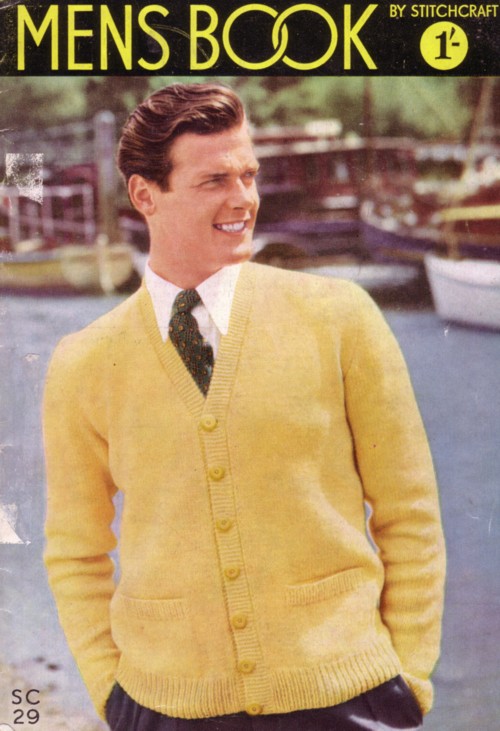
Before making it big as The Saint and James Bond, a fresh-faced Roger Moore used to earn a crust by modelling knitwear. He was rather good at it, actually. Check out The Man with the Golden Cardigan pose on this Mens Book by Stitchcraft cover from the 1950s.

Same double-knit, button-up cardie, only in moody black and white. He's laughing because the creative team have made him stand in Teddington Lock and a fish has just gone up his trouser-leg.


Probably my favourite, a "country cardigan in a manly cable and rib pattern" with obligatory 1950s nonchalant pipe-smoking pose. That's Canterbury Cathedral in the background, ecclesiastical architecture fans.

More Roger Moore here.

Thursday, 8 July 2010

1950s kettle holder and oven glove


Here's a simple knitting project from a 1950s booklet by P andB wools called Second Stage Simple Knitting. Make a thick, decorative "fancy rib" square and add a loop to turn it in to a kettle or pot holder. Make seven identical squares and sew them together to create knitted oven gloves.

Kettle holder: you will need oddments of double knitting yarn, and a pair of No 3 needles.

Using the wool double all the time, cast on 20 sts.
1st row: K2, P2 to end.
2nd row: Same as the first row.
3rd row: K every stitch.
4th row: Same as the third row.

Repeat these 4 rows 6 times more, then from the beginning of the 1st row to the end of the 3rd row once more. Cast off.

The loop: Using the wool single, cast on 18 sts. Do not knit any rows but cast off the sts straight away. Stitch the loop to one corner of the holder.

Oven glove: Make 7 pieces exactly the same as the kettle holder square above. Stitch the 7 pieces together so that they make a long strip. Fold back the two end pieces and stitch them down at the edges to make the gloves.

Tuesday, 1 June 2010

Mr June

Gentlemen, this is how to dress for the English summer. We do not want to see naked, sunburnt chests, baseball caps, or socks worn with sandals. We want crisp linen shirts, a Poppleton's knitted waistcoat and some smart pleated trousers.

If you're going to hit the beach, you are permitted to remove your tie, but that is all.

Tuesday, 18 May 2010

Mushroom Magic hat


Ah, the innocent days of the early 1950s, when you could use the phrase Mushroom Magic without hearing hippy sniggering from the back of the class.

This perky little hat is knitted from dk yarn with an angora crown. What better way to keep off the chill on a spring morning?

To make a magical mushroom hat, you will need half an ounce of angora wool, 2 oz double knitting yarn, two no 9 and no 11 needles.

Tension: 5 and three-quarter stitches and seven and three-quarter rows to one square inch on no 9 needles measured over stocking stitch.


Using no 9 needles and double knitting yarn, cast on 110 sts. Work in K1, P1 rib for 7 inches.

Change to no 11 needles and using angora for remainder of hat proceed as follows:

Next row: K5,(M1, K2, M1, K3) 20 times, M1, K5 (151 sts)

Next row: P

Work crown as follows:

1st row: K

2nd row: P

Work these 2 rows 6 times more.

Shape crown as follows:

1st row: *K13, K2 tog, rep from * to last st, K1

2nd and alt rows: P

3rd row: *K12, K2 tog, rep from * to last st, K1

5th row: *K11, K2 tog, rep from * to last st, K1

6th row: P

Continue dec in this manner on next and every alt row until 21 sts remain.

Next row: P1, (P2 tog) 10 times.

Thread yarn through remaining sts and fasten off securely.

To make up, use a back stitch to join seam, taking care to reverse seam for turn-back.

Wednesday, 12 May 2010

Typewriter art of Prince Philip

From the same Girl Annual as the duffle coat button jewellery - a lovely picture of Prince Philip, made entirely from typewriter characters.

Obviously this is what bored people did at work before Facebook was invented.

Duffle coat button jewellery

Three reasons why you may have too many duffle coat buttons and be looking for something to do with them:

1 - That failed alchemical experiment in which you discovered the way to transmute base metal into duffle coat buttons

2 - Have been left large amount of duffle coat buttons in a will

3 - You own a duffle coat button factory

Whatever the reason, here's a way to make some duffle coat button jewellery from a 1950s Girl Annual. I think Luna Lovegood would like these a lot.

To make a choker you will need 8 or 9 wooden duffle coat buttons, twice as many 3/8 inch brass screw eyes and a No 001 bead clasp. Rub the buttons down with fine sandpaper. Pierce the end of the button and screw in two eyes. Colour with a coat of poster paint, and then varnish or enamel. Tie the screw eyes together neatly but firmly with matching thread and fasten on clasp.

Variations: 1 - Have all beads identical in colouring. 2 - Shade from light to dark and back again in one colour. 3 - Keep to two alternating colours. 4 - Paint each one a different colour. 5 - Stipple with gold or silver paint afterwards.

For ear-rings, cut one button in two and tie the screw eyes with cotton on to the tiny rings of screw-on ear-rings.

Monday, 19 April 2010

1950s gloves to knit and crochet

The 1950s weren't just a classic era for chic hats. Gloves were dainty and stylish as well (and best displayed on expressively slender mitts, as above).

These four glove patterns from 1952 are recommended "for every occasion - in light shades for summer, or cheerful stripes for chilly days next autumn". The spotty gloves, black gloves and yellow and white embroidered gloves are all knitted in 3 ply. The striped gloves are crocheted in fingering thread.

If I start now, I might just have a pair of these by the autumn...

Buy a copy of this vintage 1950s knitting and crochet pattern for £1.50. You'll receive a link to download a high quality PDF document of this pattern upon payment.

Thursday, 8 April 2010

12 different 1950s hats to knit


Oh, they knew how to wear woolly hats in the 1950s. Pert little knitted confections that perched jauntily on the back of the head, veering between chic elegance and downright dottiness. Even a simple bobble hat oozes 1950s style and elegance when knitted on the small side and popped smartly on the back of the head like a tiny cocktail cap.

A swan-like neck and Grace Kelly profile are completely optional for the modern day hat wearer. I have knitted a drawer full of these little darlings in different colours and shapes over the years and can confirm that they are still as warm, stylish and wonderful as they were over 60 years ago.

Buy this knitting pattern for twelve delicious 1950s hats for £1.50. You'll receive a link to download a high quality PDF document of this pattern upon payment. Pattern has some creasing, a little writing on top corner, otherwise good.